
Spain's Empty Home Tax 2026
What Non-Residents Need to Know
If you own a beautiful holiday home on the Costa del Sol, a rustic apartment in Mallorca, or a getaway pad in Madrid, you have probably been following the news lately with a bit of a knot in your stomach. Headlines across expat forums and newspapers are sounding the alarm about Spain’s crackdown on empty properties, the Empty Home Tax / Vacant Home Tax.
With intense discussions surrounding a nationwide housing shortage, the Spanish government has officially turned up the heat. The Ley de Vivienda (Housing Law) frameworks, state programs like the Plan Estatal de Vivienda, and newly updated local town hall rules are changing how vacant property is taxed.
But what is the actual truth behind the scary headlines? Are tax authorities coming for your little slice of Mediterranean paradise just because you leave it locked up for a few months a year?
Let’s skip the confusing legal jargon, look directly at the official rules from the Agencia Tributaria (the Spanish Tax Agency), and break down exactly what this means for you in plain, simple English.
The Rules Already in Place: The "Phantom Rent" Tax
Before we look at the new rules, it helps to understand that Spain has always taxed empty second homes. Many non-resident property owners are completely unaware of this, which can lead to nasty surprises down the road.
If you own an urban property in Spain that is not your main home, and you do not have long-term tenants living in it, the Spanish Tax Agency legally assumes that the property is giving you some financial or personal benefit. They call this “Imputed Income” (Imputación de Rentas Inmobiliarias, regulated under Article 85 of Spain’s Income Tax Law).
Essentially, the government charges you income tax on a “phantom rent” that you never actually earned.
Every year, non-resident owners must file a tax return called Modelo 210 to pay this. The tax calculation works like this:
- The Base Value: The tax office looks at your property’s Valor Catastral (the official administrative value written on your local municipal property tax bill, which is normally much lower than what the house is worth on the open market).
- The Percentage: The state calculates 1.1% of that value if the local town hall has updated its property values in the last 10 years, or 2% if it has not.
- The Tax Rate: If you live in the EU, you pay a flat 19% tax on that final number. If you live outside the EU (which now includes UK citizens, as well as US and Canadian owners), you pay a flat 24%.
For a standard holiday home, this usually amounts to a few hundred Euros a year. It is an annoyance, but it is a predictable cost of owning a second home in Spain.
The Big Update: The IBI Surcharge
The real panic in the news right now stems from the government’s decision to allow local town halls (Ayuntamientos) to heavily penalise properties that remain completely dark and unused for long periods.
Instead of changing the national income tax framework, the government has updated the rules for IBI (Impuesto sobre Bienes Inmuebles), which is the annual local property tax similar to council tax or rates.
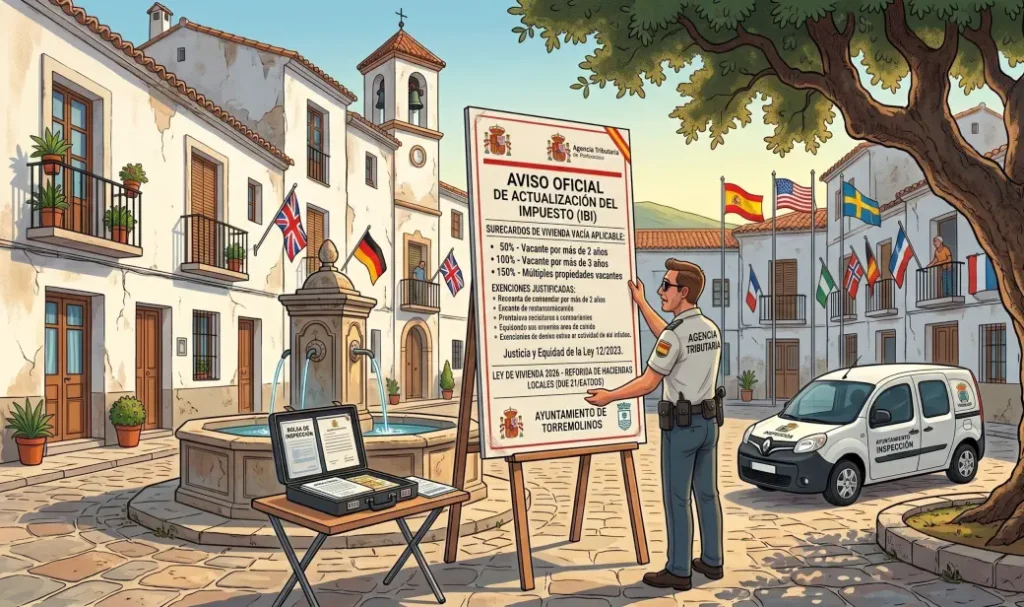
Under the official frameworks finalised for implementation, town halls across Spain now have the legal power to slap a 50% to 150% surcharge on top of your normal annual IBI bill if your house is deemed “permanently vacant.”
- The 50% Penalty: Can be applied if a house has been completely empty for over 2 continuous years without a valid reason.
- The 100% to 150% Penalty: Can be applied if the home remains empty for more than 3 years or if an owner holds multiple empty properties within the same municipality.
Imagine your local property tax suddenly doubling or more than doubling overnight. It is a serious penalty, but before you panic, you need to read the fine print.
The Fine Print: Who Does This Actually Affect?
Here is the most important piece of information that the sensationalised blog posts leave out: The heavy IBI empty-home surcharge is explicitly designed to target large corporate landlords and multi-property speculators, not normal families with one holiday home.
According to official guidelines, to be hit with this new IBI empty-home penalty, the property must meet very specific criteria:
- The Property Count: The surcharge generally applies only to individuals or companies who own four or more residential properties in Spain.
- The Timeline: The property must have been completely unoccupied “without justified cause” for at least two consecutive years.
If you are a normal expat who owns a primary home back in your home country and one or two holiday properties in Spain that you visit a few times a year for vacations, this new surcharge does not apply to you. Furthermore, the law lists several “justified causes” for a home sitting empty. You are legally exempt from the penalty if:
- The property is actively listed for sale (for up to 1 year) or for rent (for at least 6 months).
- The property is undergoing major building renovations.
- The property is tied up in a pending court case or inheritance dispute.
- The owner must leave the property empty for certified health reasons, dependency, or temporary work relocation.
If your holiday home is left unoccupied for long periods, it is recommended to use a local Non-rental Keyholding and Property Management Service on the Costa Del Sol.
How Is the Government Checking Up on Empty Homes?
You might be wondering: “How does the tax office even know if my house is empty or if I am just a quiet resident?”
The answer lies in modern data technology. The Spanish Tax Agency has started cross-checking data directly with national utility providers.
If a home shows near-zero electricity or water consumption over an entire twelve-month period, the digital system automatically flags the property as “permanently vacant.” Regional authorities are increasingly using this data to identify properties that are holding back local housing supply. If your house has normal, seasonal spikes in utility usage from your holiday visits, the system can clearly see that the home is actively used and not abandoned.
Carrot vs. Stick: The Government's New Rental Incentives
While the government is using the “stick” of higher property taxes on large landlords, it is also introducing a “carrot” to encourage owners to open their doors to tenants.
Under the latest housing strategies, the government is rolling out public programs that offer financial help to owners who voluntarily put their empty homes up for long-term, affordable local rentals. In some regions, owners can receive up to €600 per month in subsidies if they place their property into public housing programs.
Additionally, the state offers massive personal income tax reductions, ranging from 50% to 90%, on rental income you earn if you rent your property to young people or lower the rent compared to previous years. This seems to be linked with the recent NRA Rental Registration Number strategy to reduce short-term rentals.
The Takeaway for Expats
The proposed and newly active updates to Spain’s empty home policies can sound incredibly intimidating, but the reality is far more reasonable than the rumours suggest.
If you are an investor holding a large portfolio of vacant Spanish apartments, it is time to consider long-term rental options or face steep financial penalties.
However, if you are a typical expat with a single holiday home that you love and visit regularly, you can breathe a sigh of relief. Keep paying your standard annual IBI tax to your town hall, make sure your accountant files your annual Modelo 210 for your imputed income, and keep enjoying your time under the Spanish sun.
*Update*
Torremolinos has recently moved registered tourist-use properties, known as Viviendas de Uso Turístico (VUTs), from the domestic rubbish category to the industrial or commercial category. This has caused an increase of more than 3 times the normal basura bill. Fuengirola have done something similar as well as other local councils.