
Vehicle Identification
Registration number, VIN, make, model, first registration date and other identifying information.
Spanish vehicle check · Official DGT information
A DGT vehicle check or Spanish number plate check ‘Informe de Vehículo’, is essential before buying a second-hand vehicle in Spain. We can obtain the full DGT vehicle report for you and send it by email for €15.
Simple remote service · €15
Send us the Spanish registration number (matrícula) or VIN/chassis number (número de bastidor), make the payment and receive the official full DGT vehicle report by email.
Email or WhatsApp us the matrícula (Spanish licence plate number) or the VIN/chassis number (número de bastidor). The vehicle must have been registered in Spain at some point.
We will send you an EU IBAN for payment by SEPA bank transfer. We do not accept SWIFT or other international transfer methods, as additional bank charges may be deducted from the payment.
We obtain the full DGT vehicle report and send it to the email or WhatsApp number address you contacted us from. *Report explanations aren’t included. For an explanation, use our Vehicle Protection Pack.
For vehicles registered in Spain, or previously registered in Spain · Reports requested outside office hours are sent on the next working day
A full DGT report is a valuable first check. Before paying a seller, our €49 Vehicle Buyer Protection Pack gives you a more complete picture by combining two official sources with an experienced, plain-English assessment and explanation.
Buyer Protection Pack
€49
Please allow up to 2 business days for the nota simple delivery
Protect Me Before I Buy This Vehicle I only need the DGT reportThe Vehicle Buyer Protection Pack is an administrative and records-based assessment. It is not a mechanical inspection, vehicle valuation, legal opinion or guarantee. We recommend an independent mechanical inspection before buying any second-hand vehicle.
Check before you pay
Buying a second-hand vehicle in Spain can become expensive and stressful if a recorded problem only appears when you try to put the vehicle into your name. A current DGT report helps you check the vehicle's official Spanish record before committing to the purchase.
The official vehicle record
The information varies according to the vehicle's age and recorded history, but a complete report may include the following sections.
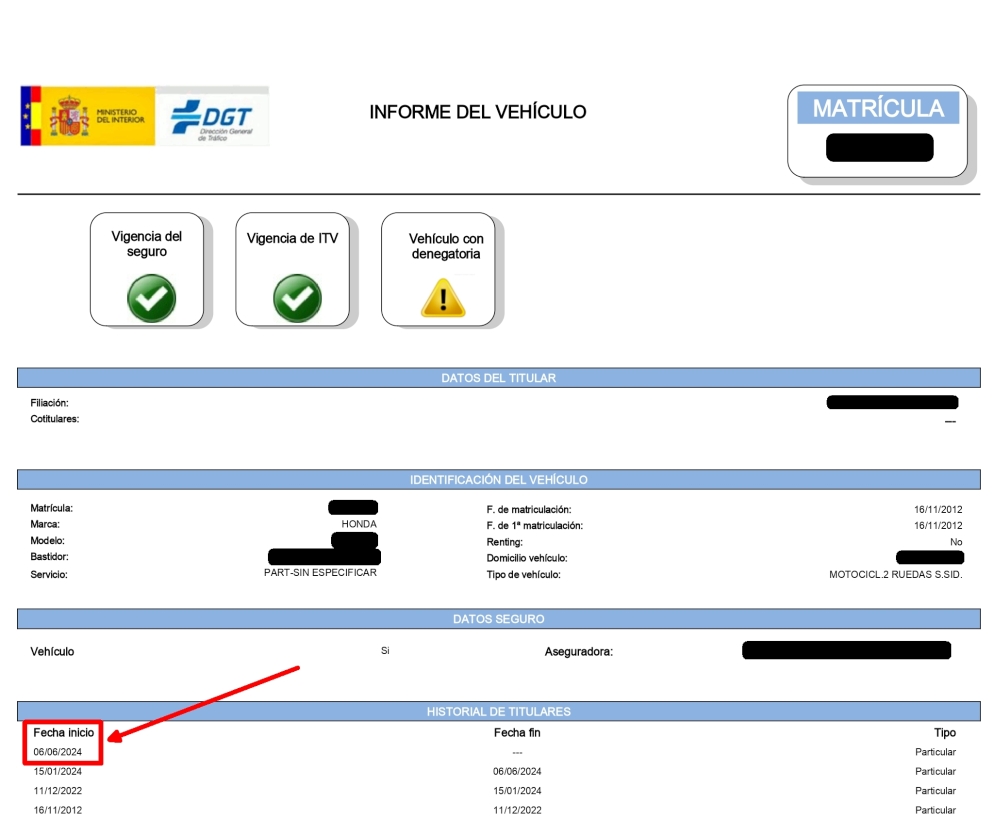
Registration number, VIN, make, model, first registration date and other identifying information.
Current registered ownership information, co-owners where recorded and the number and dates of previous ownership changes.
Fuel type, engine power, emissions, dimensions, weight, seats and other technical specifications held by the DGT.
Inspection dates, results, expiry dates, defect codes and mileage recorded during previous ITV inspections.
Whether the vehicle is active, temporarily or permanently deregistered and whether a recorded issue affects its use or transfer.
Whether compulsory insurance is recorded and, where available, the insurer shown in the official information.
Recorded embargoes, seals, leasing, reserva de dominio and other restrictions that could affect the vehicle or its transfer.
Pending manufacturer recalls, Euro NCAP information and maintenance records supplied through connected systems, where available.
A DGT report is not a complete accident or repair history, an itemised list of personal traffic fines, or a guarantee of genuine mileage or mechanical condition. Imported vehicles may also have limited Spanish history from before they were registered in Spain.
Choose the right level of checking
The best choice depends on whether you need a quick indication, the full Spanish record or a more complete assessment before buying the vehicle.
Free
A useful first check that confirms basic vehicle identification and shows whether the DGT has recorded an incident or warning.
€15
The detailed official DGT information supplied by email without you needing your own Cl@ve account or digital certificate.
€49
The stronger option for a used-vehicle purchase: two official sources reviewed together and explained in clear English.
Other DGT report types: the DGT also offers specialist reports covering technical data, charges, vehicles registered in your name, unregistered vehicles and vehicle ownership during specified dates. The reduced and complete reports are normally the most relevant choices when checking a used vehicle before purchase.
Two different official sources
The documents overlap in some areas, but they are issued from different records and serve different purposes. When buying a second-hand vehicle, checking both provides a more complete picture.
Our service: €15
Issued from the DGT's vehicle records and focused on the traffic, technical and administrative situation of the vehicle.
Our individual service: €20
Issued from the Registro de Bienes Muebles and focused on registered financial and legal interests attached to the vehicle.
The €49 Vehicle Buyer Protection Pack combines both official sources with a clear English assessment, warning explanation and green, amber or red recommendation before you pay the seller.
Avoid problems after paying
In Spain, the buyer is responsible for changing the registered ownership. Missing documents or a restriction attached to the vehicle can delay the process or make the transfer impossible until the problem is resolved.
If a previous year's municipal road tax remains unpaid and is recorded against the vehicle, the ownership transfer may be blocked.
A seller may have only recently registered the vehicle. If the new Permiso de Circulación has not been issued, another transfer may not yet be possible.
A reserva de dominio, embargo, seal, deregistration or another administrative limitation can require investigation and action before the vehicle can be put into your name.
Check before you pay the seller
A fresh DGT report can reveal valuable information about a vehicle's Spanish record. If you are buying the vehicle, choose the Buyer Protection Pack for both official sources, an English assessment and clear recommended next steps.
Both services are completed remotely for Spanish-registered vehicles.
DGT vehicle report questions
Clear answers about ordering a Spanish vehicle report, what it contains and which check is best when buying a second-hand vehicle in Spain.
You will usually receive the report within two hours of our receiving payment during working hours. Reports requested outside office hours are normally sent on the next working day. An occasional DGT website outage may cause a delay.
If the report has not arrived, check your spam or junk folder and make sure you supplied the correct email address. If it is still missing, contact us and we will check its delivery.
For our €15 DGT vehicle report service, send us the Spanish licence plate number (matrícula) or the VIN/chassis number (número de bastidor). The vehicle must have been registered in Spain at some point.
Our €15 report service does not come with any explanation, it is a stand-alone service. If you need an explanation of the information in the report then please use our vehicle buyer protection pack .
Yes. Most DGT vehicle reports can be requested by anyone, so you do not need to be the registered owner or obtain the seller's permission. This allows you to check a vehicle independently before agreeing to buy it.
The reduced DGT report is free. It confirms basic identification information and indicates whether the DGT has recorded a warning or incident, but it does not explain the issue.
A detailed report currently carries an €8.67 DGT fee. We can obtain the full DGT vehicle report for €15, including that fee, so you do not need your own Cl@ve account or digital certificate.
Depending on the vehicle's age and the information recorded, a full DGT vehicle report may include:
The amount of information varies. A newer or recently imported vehicle may have little Spanish history, and a blank section normally means the DGT has no information recorded for that category.
A DGT report is not a complete accident-history, finance-history or mechanical-condition check. Although it may include mileage recorded during ITV inspections and some maintenance information supplied to connected systems, it cannot guarantee the genuine mileage or show every accident, repair or service.
It also does not normally provide:
Compare the report with the service history, invoices and an independent mechanical inspection.
A DGT report can reveal administrative issues or restrictions that may affect a change of ownership, including unpaid road tax recorded by the DGT, a reserva de dominio, an embargo, a vehicle deregistration or another limitation. However, it is not an absolute guarantee that the transfer will be accepted.
If the report shows a warning or incident, do not pay for the vehicle until you understand it. Ask the seller for evidence that the issue has been resolved and obtain a new report where appropriate.
A DGT vehicle report focuses on information held by Spain's Traffic Authority, including the vehicle's technical and administrative status, ITV history, ownership history and recorded transfer restrictions.
A Nota Simple de Vehículo comes from the Registro de Bienes Muebles and provides more detail about registered financial or legal burdens, such as finance agreements, leasing, embargoes or a reserva de dominio. Our individual Nota Simple service costs €20.
A vehicle report reflects the records available when it is issued. Obtain a fresh Spanish vehicle report shortly before paying a deposit or completing the purchase. An older report may not show a restriction or administrative change recorded more recently.
A DGT report is based on Spain’s vehicle records. If the vehicle has never been registered in Spain, a DGT report will not provide a Spanish history. If it was previously registered in Spain, we may be able to obtain the report using its VIN/chassis number even if it now has foreign plates.
Unfortunately, payment is non-refundable when an incorrect licence plate number is supplied. Please check the Spanish registration number carefully before sending it to us.
Understand the ITV history
Search for the code or component shown in the Historial de Inspecciones Técnicas section of a DGT report. The inspection result will also show whether the recorded defect is LEVE, GRAVE or MUY GRAVE.
84 defect codes
| Code | Reason for the defect |
|---|---|
| 01.01 | Documentation |
| 01.02 | VIN number |
| 01.03 | Number plates |
| Code | Reason for the defect |
|---|---|
| 02.01 | Front underride |
| 02.02 | Body and chassis |
| 02.03 | Coupling devices (towbar) |
| 02.04 | Mudguards and anti-spray devices |
| 02.05 | Windscreen wipers and washers |
| 02.06 | Side protections |
| 02.07 | Rear protections |
| 02.08 | Doors and steps |
| 02.09 | Mirrors |
| 02.10 | Signs on vehicles |
| 02.11 | Exterior spare-wheel carrier |
| 02.12 | Safety glass |
| Code | Reason for the defect |
|---|---|
| 03.01 | Seats and their anchorages |
| 03.02 | Safety belts and their anchorages |
| 03.03 | Child restraint device |
| 03.04 | Demisting and defrosting |
| 03.05 | Anti-theft system and alarm |
| 03.06 | Direct field of vision |
| 03.07 | Load-retention devices |
| 03.08 | Speed indicator (odometer) |
| 03.09 | Interior protrusions |
| Code | Reason for the defect |
|---|---|
| 04.01 | Dipped-beam and main-beam headlights |
| 04.02 | Reversing lights |
| 04.03 | Direction-indicator lights |
| 04.04 | Hazard-warning signal |
| 04.05 | Brake lights |
| 04.06 | Rear registration-plate light |
| 04.07 | Position lights |
| 04.08 | Fog lights |
| 04.09 | Clearance lights |
| 04.10 | Retro-reflectors |
| 04.11 | Interior lighting |
| 04.12 | Audible warning |
| 04.13 | Parking lights |
| 04.14 | Door-opening warning |
| 04.15 | Special lighting and signalling |
| Code | Reason for the defect |
|---|---|
| 05.01 | Noise |
| 05.02 | Spark-ignition engine vehicles |
| 05.03 | Compression-ignition engine vehicles |
| Code | Reason for the defect |
|---|---|
| 06.01 | Service brake |
| 06.02 | Secondary (emergency) brake |
| 06.03 | Parking brake (handbrake) |
| 06.04 | Overrun brake |
| 06.05 | Anti-lock braking device |
| 06.06 | Deceleration device |
| 06.07 | Brake pedal |
| 06.08 | Vacuum pump or compressor and reservoirs |
| 06.09 | Low-pressure warning indicator |
| 06.10 | Hand-operated brake control valve |
| 06.11 | Brake valves |
| 06.12 | Accumulator or pressure reservoir |
| 06.13 | Trailer-brake connection |
| 06.14 | Brake servo and master cylinder (hydraulic systems) |
| 06.15 | Rigid brake pipes |
| 06.16 | Flexible brake hoses |
| 06.17 | Brake linings |
| 06.18 | Brake drums and/or discs |
| 06.19 | Cables, rods, levers and connections |
| 06.20 | Brake-system cylinders |
| 06.21 | Load-sensing valve |
| 06.22 | Automatic slack adjusters |
| Code | Reason for the defect |
|---|---|
| 07.01 | Wheel alignment |
| 07.02 | Steering wheel and column |
| 07.03 | Steering box |
| 07.04 | Steering linkages and ball joints |
| 07.05 | Power steering |
| Code | Reason for the defect |
|---|---|
| 08.01 | Axles |
| 08.02 | Wheels |
| 08.03 | Tyres |
| 08.04 | Suspension |
| Code | Reason for the defect |
|---|---|
| 09.01 | General condition of the engine |
| 09.02 | Intake system |
| 09.03 | Exhaust system |
| 09.04 | Transmission |
| 09.05 | Vehicles using LPG as fuel |
| Code | Reason for the defect |
|---|---|
| 10.01 | Transport of dangerous goods |
| 10.02 | Transport of perishable goods |
| 10.03 | School and minor transportation |
| 10.04 | Tachograph |
| 10.05 | Speed limiter |
| 10.06 | Unauthorised alterations or modifications |
No matching defect code found.
Source reference: itv.com.es. The English wording is provided as a guide; always follow the official result issued by the inspection centre.