
Updated: 13 November 2026
If you own an apartment or holiday home in Spain and rent it out to visitors, you could soon have to charge 10% VAT on short stays, and just when you were getting over the NRA farce!
Spain has approved a change that will bring many furnished holiday rentals into the VAT system from 1 December 2026. It could affect owners who currently let their properties without charging VAT.
Congress confirmed the measure on 12 November. That means owners have less than three weeks to review their bookings, prices and tax arrangements. It doesn't mean every apartment will be treated in the same way.
Here's what the legislation actually says, how it could affect your rental income and what you should check before December.
At a glance: What will the 10% VAT mean for you?
Here's what owners of furnished holiday apartments need to know before 1 December.
A simple example: Your holiday apartment earns €1,000
Let's say your apartment brings in €1,000 from a week's rental. You also have €200 in qualifying expenses, excluding VAT, on which you've paid 21% VAT (€42).
If you keep your advertised rental price at €1,000, here's how the figures compare.
Under the current VAT exemption
From 1 December, if 10% VAT applies
In this simplified example, you'd be €48.91 worse off if you kept the same guest price and could recover all €42 of the expense VAT.
But if you increased the price to €1,100 including VAT, and guests still booked at that price, your rental amount before VAT would remain €1,000. You might also benefit from recovering VAT on qualifying expenses.
The important point: The new VAT wouldn't necessarily cost every owner the same amount. Your prices, expenses and entitlement to VAT deductions would all make a difference.
These figures assume that the whole €42 of expense VAT is deductible when the new treatment applies. They exclude booking commissions, income tax and other costs. Actual deductions depend on the circumstances and tax rules.
What's actually changing?
At present, many owners of furnished holiday apartments don't charge VAT on their rental income.
That's because Spanish tax rules have generally treated the straightforward letting of an apartment differently from running a hotel.
For example, if you rent out a furnished apartment for a week and provide clean bedding when guests arrive, but don't offer hotel-style services during their stay, the rental is generally exempt from VAT.
From 1 December 2026, the new legislation changes that for qualifying shorter bookings.
Under the published rules, furnished apartments and houses rented for 30 nights or fewer to the same tenant will generally attract 10% VAT from 1 December, even if no hotel-style services are provided.
The legislation includes an exception where the rented accommodation is the landlord's own habitual residence.
This means many ordinary holiday lets will become subject to VAT for the first time.
Would the new VAT affect your apartment?
The rules aren't limited to properties officially described as tourist accommodation.
What matters is the type of property, how it's rented, the length of the stay and whether an exemption applies.
Here's how some common situations could be affected.
| Your rental situation | Likely position from 1 December |
|---|---|
| Furnished holiday apartment rented for 7 nights | 10% VAT |
| Furnished apartment rented for 14 nights | 10% VAT |
| Furnished apartment rented for exactly 30 nights | 10% VAT |
| Furnished apartment rented for 31 nights without hotel-style services | Generally exempt under ordinary rental rules |
| A room or accommodation in your own habitual residence | May qualify for the habitual residence exception |
| Accommodation with hotel-style services | Generally already subject to 10% VAT |
These examples assume the accommodation is in mainland Spain or the Balearic Islands and that no other special circumstances apply.
The legislation uses 30 nights, not 30 working days or one calendar month.
So if you rent your apartment to the same guests for exactly 30 nights, the new rule will normally apply from 1 December.
What if you only rent your apartment a few weeks each year?
You shouldn't assume you're exempt just because you don't rent your property very often.
The new provision doesn't introduce a minimum annual rental income or a minimum number of bookings.
Someone renting an apartment for three weeks each summer could therefore be affected, just as someone with a fully booked holiday calendar could be.
The number of properties you own doesn't, by itself, determine whether the new VAT applies.

What if you live in the UK and own an apartment in Spain?
This is particularly relevant to British and other non-resident property owners.
You might live permanently in the UK, Ireland or elsewhere but rent out an apartment in Marbella, Fuengirola, Torremolinos or another part of Spain.
Living outside Spain wouldn't automatically exempt you from the new VAT rules.
The tax treatment generally depends on where the accommodation is located and the nature of the rental, rather than simply where the owner lives.
It's also worth remembering that VAT is different from income tax.
If you currently declare rental income in Spain as a non-resident, the VAT wouldn't replace those obligations. You could have responsibilities for both taxes.
That's something to discuss with your accountant before the new rules apply.
For further information, see our article on tax developments for non-EU property owners in Spain.
How would the 10% VAT affect your rental income?
As the example above shows, a 10% VAT charge doesn't automatically mean you'll earn 10% less or that every guest must pay 10% more.
Some owners may choose to increase their prices, while others may prefer to keep their advertised rates unchanged.
And if you become entitled to recover VAT on qualifying property expenses, that could reduce the overall cost.
Your actual position will depend on your rental income, running costs, pricing decisions and the VAT deductions available to you.
What about Airbnb and Booking.com?
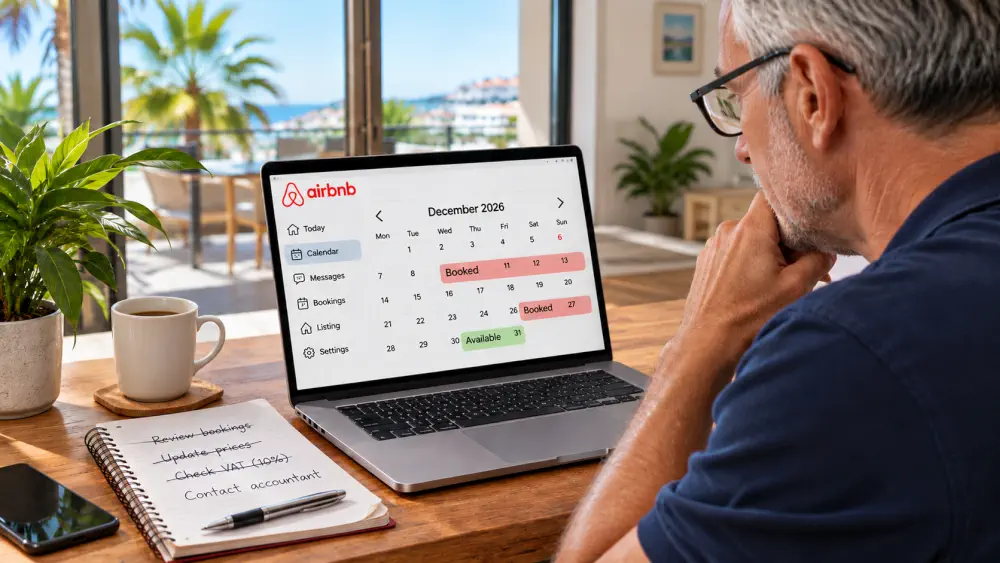
If you advertise your apartment through Airbnb, Booking.com or a rental agency, don't assume the platform will automatically handle everything for you.
There's a difference between a company collecting a guest's payment and being responsible for declaring VAT on the accommodation itself.
Depending on how your arrangements work, the VAT responsibility may remain with you as the property owner.
Before December, you'll want to establish:
- Whether your advertised prices will include VAT.
- Whether the platform or your rental manager can show VAT correctly on booking documents.
- Who issues invoices to guests when required.
- Who is responsible for keeping the records your accountant needs.
It's worth checking your listings and booking systems now, rather than assuming the platforms will make any necessary changes for you.
What about bookings already made for December?
If you've already accepted bookings for December or 2027, you may have agreed rental prices before the new 10% VAT rules were approved.
For example, a guest might have booked your apartment in October for €1,000, paid a €200 deposit and agreed to pay the remaining €800 in December.
The important question is how the new VAT applies to money received before 1 December and payments due afterwards. Spanish VAT rules take account of when rent becomes payable and when advance payments are received, not simply when the booking was made.
We haven't yet found specific AEAT guidance confirming how deposits paid before 1 December should be treated under this particular change. If you've already accepted deposits or full payments for future stays, ask your accountant to check them before changing prices or issuing VAT invoices.
Will you have to register with Hacienda?
Potentially, yes.
If your holiday rental becomes subject to VAT, you may have to register or update your existing tax details with the Spanish Tax Agency, known as the Agencia Tributaria or Hacienda.
For some owners, that could involve Modelo 036, the form used to register or change details relating to economic activities and tax obligations.
There may also be requirements to keep VAT records and submit periodic returns, commonly using Modelo 303.
However, not every owner will necessarily have the same registration requirements.
For example, someone already registered for VAT may have different paperwork from an owner who has never charged it before.
Non-resident owners can also have additional considerations.
Now that Congress has approved the decree, don't leave this until December. Ask your accountant or gestor promptly whether your tax registration needs updating and when any filing must be made. Don't submit Modelo 036 using guesswork.
Could you claim back VAT on property expenses?
Possibly, and it's an important part of the picture that shouldn't be overlooked.
When an activity becomes subject to VAT, there may be circumstances in which the owner can deduct VAT paid on qualifying expenses connected with that activity.
Depending on the circumstances, these might include certain maintenance costs, professional services or other business expenses.
But you shouldn't assume that all VAT on your property expenses will become deductible.
The rules can be complicated, particularly if you sometimes use the apartment yourself, rent it under different arrangements or have previously operated under a VAT exemption.
For now, keeping organised invoices and records is a sensible precaution.
Your accountant can then assess what, if anything, may be deductible under the new rules.
What about rentals lasting more than 30 nights?
The new short-stay provision specifically covers furnished rentals lasting no more than 30 nights to the same tenant.
So a genuine longer-term or seasonal rental of more than 30 nights wouldn't automatically fall under this particular VAT rule.
However, that doesn't mean every longer booking is VAT-exempt.
Existing rules concerning hotel-style services and other rental arrangements would still matter.
And there's another important distinction: the VAT rules and the legal requirements for seasonal rental contracts aren't the same thing.
Changing a seven-night holiday booking into a contract described as a 31-night rental wouldn't, by itself, establish that the arrangement complies with the law.
Does the 10% VAT apply everywhere in Spain?
The change concerns Spanish VAT, known as IVA.
It would generally apply in mainland Spain and the Balearic Islands, including the Costa del Sol, Costa Blanca, Costa Brava and Mallorca.
The Canary Islands have a separate indirect-tax system, known as IGIC. Ceuta and Melilla also have their own indirect-tax arrangements.
Owners in those territories shouldn't assume that the mainland 10% VAT rule applies to their properties in the same way.
What should holiday rental owners do before December?
With the parliamentary vote now completed, there's less than three weeks until the new VAT treatment is due to apply.
You don't need to guess at your tax obligations, but you should start preparing now.
- Check how many bookings are for 30 nights or fewer.Look through your calendar and get an idea of how much of your rental income could be affected.
- Review your rental prices.Work out what a 10% VAT charge would mean if you passed it on to guests, compared with keeping your existing rates.
- Check future bookings and deposits.Pay particular attention to bookings from December onwards, including payments already received. Keep confirmations and payment dates together.
- Organise your income and expense records.Keep invoices, payment records, property expenses and details of commissions charged by booking platforms or rental managers.
- Speak to your accountant or gestor now.Ask whether you need to register for VAT, modify an existing registration or change how you issue invoices before 1 December.
- Make changes with the right advice.Check the latest AEAT instructions, agree any necessary registrations with your accountant and confirm the treatment of existing bookings before adjusting invoices or prices.
So, is the 10% holiday rental VAT going ahead?
Yes, as the law stands on 12 November 2026. The Standing Committee of Congress has approved Royal Decree-law 29/2026, and the published legislation sets the new VAT treatment to apply from 1 December.
That doesn't mean every short-term rental owner will have exactly the same paperwork, deductions or obligations. The details depend on the property, the type of booking and the owner's circumstances.
For anyone who owns a holiday rental apartment in Spain, the best approach now is to check whether the change affects your bookings, organise your records and ask your accountant what needs to be done before December.
We'll continue checking official updates, including the formal publication of the parliamentary validation and any further guidance from the Spanish Tax Agency.
Official sources
We've based this guide on information published by the Spanish authorities rather than speculation or advice from commercial websites.